DOI: https://doi.org/10.1103/ryqw-r7s5
In the rapidly expanding field of quantum technology, sensing has emerged as a promising application, already deployed in real-life scenarios such as MRI. In particular, when quantum systems operate near a phase or critical transition, much like water near its boiling point during the liquid-to-vapour transition, they can become highly sensitive detectors of changes in the system.
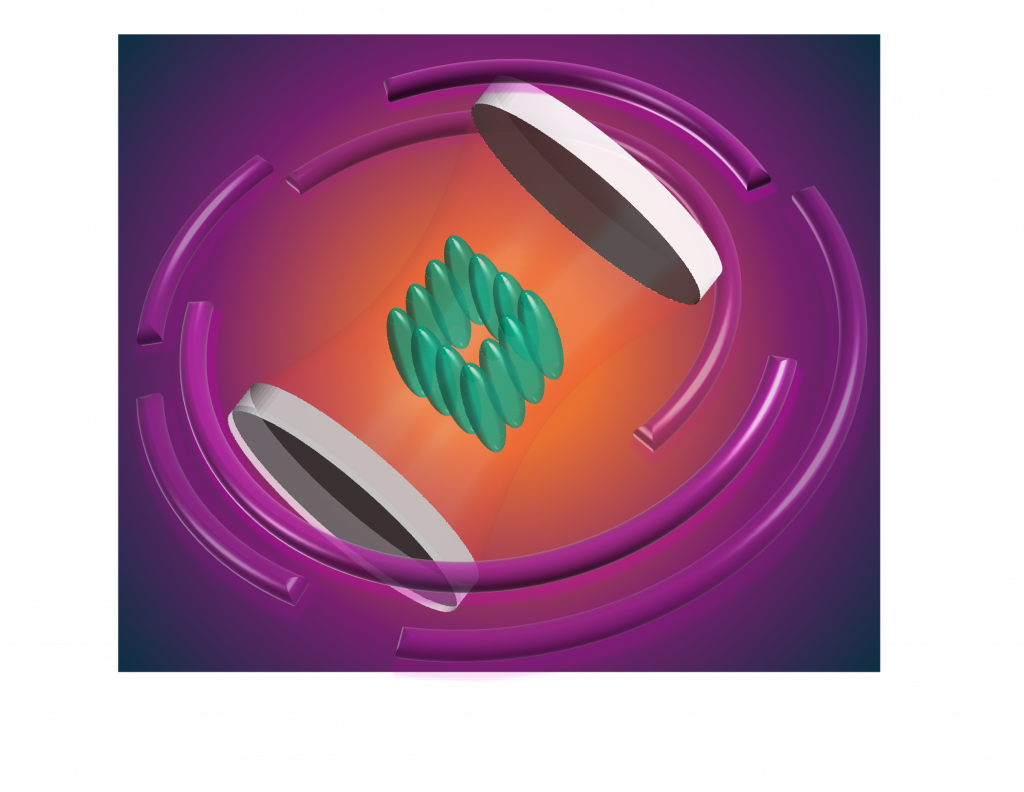
In a recent Letter published in Physical Review Research, a collaboration led by Prof. Ludwig Mathey (University of Hamburg) and Prof. Jayson Cosme (National Institute of Physics, UP Diliman) proposed a novel design for a quantum-based rotation sensor, similar to a gyroscope. In their work, they propose to use cold atoms arranged in a square array trapped between two highly reflective mirrors, which forces light to interact with the atoms. This light-matter interaction gives rise to exotic phases of matter made of entangled atoms and light. The researchers demonstrate that the critical point separating two distinct phases strongly depends on the system’s rotation speed. This leads to the light being emitted, which occurs in only one of the two phases, being sensitive to subtle changes in the rotation frequency. This sensitivity allows the system to function as a precise rotation sensor, enabled by a phase transition in the quantum world.