

May T. Lim
Education:
BS – University of the Philippines, Diliman
MS – University of the Philippines, Diliman
PhD – University of the Philippines, Diliman (2003)
Academic Group: Instrumentation Physics Laboratory
Fields of Interest: Computational statistical physics (Monte Carlo methods, agent-based models, networks)
Dr. May T. Lim is a Professor of the National Institute of Physics (NIP) at the University of the Philippines. She is also currently the Adviser of Complex Systems Team (CXTeam) sub-group of the Instrumentation Physics Laboratory. She obtained her PhD degrees from the University of the Philippines Diliman in 2003. Her Fields of Interest: Computational statistical physics (Monte Carlo methods, agent-based models, networks).
She is one of the recipients of the Outstanding Young Scientist (OYS) Award from the National Academy of Science and Technology (NAST) Philippines. She received an award Most Outstanding PhD Graduate, College of Sicence, 2002.
Dr. Lim honoured in the field of Physics for her work in understanding and mmodelling socio-technical systems that are rich in empirical data.
Dr. Lim is currently the Deputy Director for Academic Affairs, National Institute of Physics (NIP), University of the Philippines. Associate Professor of Physics, NIP. Samahang Pisika ng Pilipinas, President.
Transport Network Efficiency During Typhoon Relief Operations
May T. Lim, Ph.D., Reinabelle C. Reyes, Ph.D., and J.C. Albert C. Peralta
Instrumentation Physics Laboratory, National Institute of Physics,
University of the Philippines, Diliman, Quezon City, Philippines
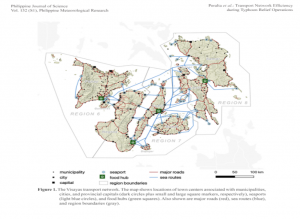
The Transport network is the backbone of relief delivery operations during natural disasters such as typhoons. In this study, we constructed a transport network model connecting the cities and municipalities of the Visayas island group in the Philippines with their regional relief or food hubs. Using this model, we simulated relief delivery under various damage scenarios arising from the impact of a chosen typhoon. Using Typhoon Haiyan (“Yolanda”) as an example, we measured the relief delivery efficiency of the transport network over a range of damage scenarios relative to the baseline undamaged case. We find that the Visayas transport network is sensitive to small damages, with 30 out of 251 town centers (12%) getting disconnected from the network and relief delivery efficiency dropping to 75%, resulting in time delays of up to 12 h, when just 1% of the nodes are damaged. Our results explain the difficulty of achieving timely relief delivery efforts in the aftermath of typhoons, especially in archipelagic geographies. We also present a prototype decision support tool that can efficiently generate simulations of multiple projected scenarios, including different typhoon paths and additional food hub locations, to help decision-makers forecast expected improvements in relief delivery efficiency. This tool underlines the importance of strategic prepositioning of relief goods and data-driven disaster risk reduction and management plans. © 2023, Department of Science and Technology. All rights reserved.
Author keywords
complex networks; disaster response; disaster science; network science; relief operations; transport networks
Selected Publications
- Transport Network Efficiency During Typhoon Relief Operations, J. C. Albert C. Peralta, May T. Lim, and Reinabelle C. Reyes. Transport network efficiency during typhoon relief operations. Philippine Journal of Science, 152(S1):185 – 195, 2023.
- Crossover transitions in a bus-car mixed-traffic cellular automata model D.N. Dailisan and M.T. Lim. Crossover transitions in a bus-car mixed-traffic cellular automata model. Physica A: Statistical Mechanics and its Applications, 557, 2020.
- Modeling the residential distribution of enrolled students to assess boundary-induced disparities in public school access L.J.M. Rubio, D.N. Dailisan, M.J.P. Osorio, C.C. David, and M.T. Lim. Modeling the residential distribution of enrolled students to assess boundary-induced disparities in public school access. PLoS ONE, 14(10), 2019.
- Email: may@nip.upd.edu.ph
- URL: http://cxteam.liknayan.com/