

Maricor N. Soriano
Education:
PhD – University of the Philippines, Diliman
MS – University of the Philippines, Diliman
BS – University of the Philippines, Diliman
Academic Group: Instrumentation Physics Laborator
Fields of Interest: Applied Physics, Biometrics, Physics Education and Physics.
Dr. Maricor N. Soriano is a Professor of the National Institute of Physics (NIP) at the University of the Philippines. She is also currently the Adviser of Video and Image Processing sub-group of the Instrumentation Physics Laboratory. She obtained her BS, MS, and PhD degrees from the University of the Philippines Diliman in 1992, 1995, and 1997.
She won the DOST PCIEERD R&D Prize year 2018. In 2013, Dr. Soriano is a recipient of The Outstanding Women in the Nation’s Service (TOWNS) awardee in Applied Physics, Third World Academy of Science Physics Prize year 2009. She was named NRCP Outstanding Young Scientist (Applied Physics), NAST-DOST year 2006. Most Outstanding Ph.D. Graduate of the College of Science, UP Diliman, 1998. Third Prize – Philippine Talent Search for Young Scientists, NAST, 1997. Dean’s Medallion – Best Undergraduate Thesis in Physics, UP Diliman, 1992.
She is specializes in developing hardware and software tools for video and image processing. Her work spans multidisciplinary domains such as coral reef imaging, cultural heritage conservation, video analysis of sports, and medical imaging.
Dr. Soriano is a former Deputy Director for Facilities and Resources (July 2001 – May 2002), and Deputy Director for Academic Affairs (June 2006 – June 2011), Former President, Samahang Pisika ng Pilipinas (SPP). She is also currently the Program Leader of STAMINA4Space (February 2021 – Present).
3D Fourier ghost imaging via semi-calibrated photometric stereo
Maricor N. Soriano, Ph.D., Nathaniel Hermosa II, Ph.D., and Ritz Ann Aguilar
Instrumentation Physics Laboratory, National Institute of Physics,
University of the Philippines, Diliman, Quezon City, Philippines
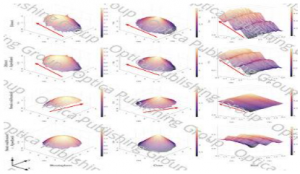
We achieved three-dimensional (3D) computational ghost imaging with multiple photoresistors serving as single-pixel detectors using the semi-calibrated lighting approach. We performed imaging in the spatial frequency domain by having each photoresistor obtain the Fourier spectrum of the scene at a low spectral coverage ratio of 5%. To retrieve a depth map of a scene, we inverted, apodized, and applied semi-calibrated photometric stereo (SCPS) to the spectra. At least 93.5% accuracy was achieved for the 3D results of the apodized set of images applied with SCPS in comparison with the ground truth. Furthermore, intensity error map statistics obtained at least 97.0% accuracy for the estimated surface normals using our method. Our system does not need special calibration objects or any additional optical components to perform accurate 3D imaging, making it easily adaptable. Our method can be applied in current imaging systems where multiple detectors operating at any wavelength are used for two-dimensional (2D) imaging, such as imaging cosmological objects. Employing the idea of changing light patterns to illuminate a target scene and having stored information about these patterns, the data retrieved by one detector will give the 2D information while the multiple-detector system can be used to get a 3D profile.
3D reconstructions of the hemisphere, cone, and sine wave objects under four different cases. Apart from the angular tilt for the direct photometric stereo cases (first two columns), the general 3D shape of the objects were more or less retrieved. The unapodized semi-calibrated case (third column), especially the sine wave object, has too much noise artifacts in the set of raw images. As a result, the non-linear least squares algorithm had difficulty looking for optimal solutions, yielding inaccurate 3D reconstructions. The apodized semi-calibrated case (fourth column) had the best results. Arrows were added to emphasize the tilt of the images
Email: jing.soriano@gmail.com
- Email: msoriano@nip.upd.edu.ph