
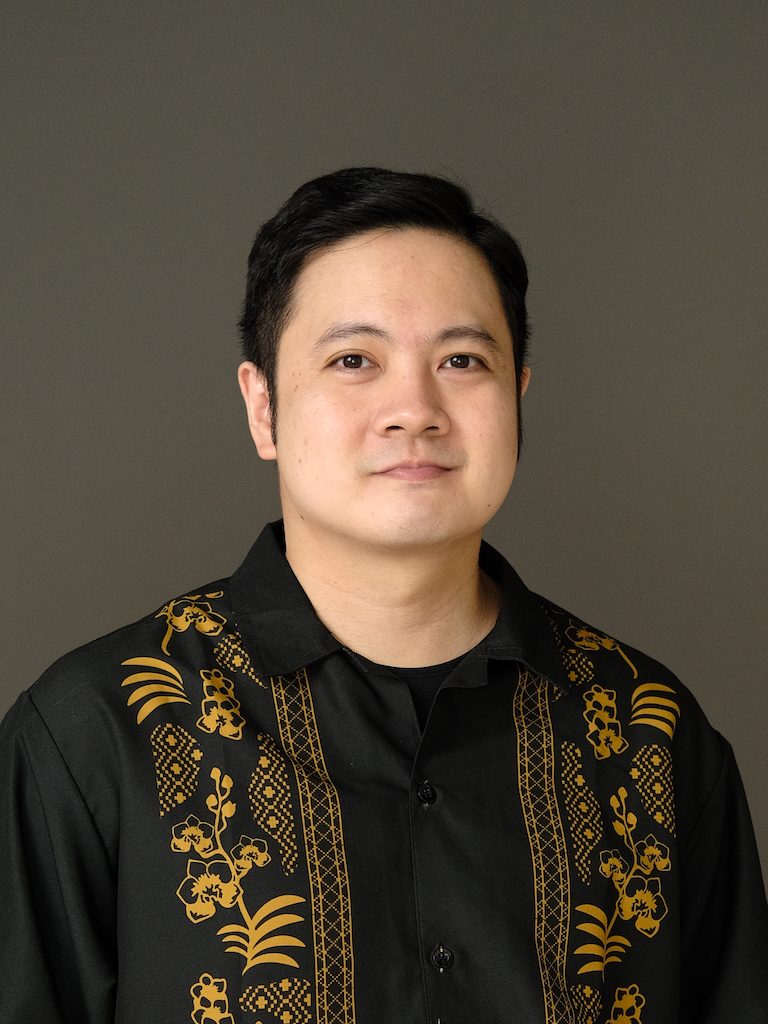
Emmanuel Soliman M. Garcia
Education:
PhD – University of California, San Diego
MS – University of the Philippines, Diliman
BS – University of the Philippines, Diliman
Dr. Emmanuel Soliman M. Garcia is an Associate Professor at the National Institute of Physics, University of the Philippines Diliman. His research spans marine geophysics, seismology, and lithospheric deformation, with a focus on seafloor tectonics, ocean-bottom observations, and gravity field analysis. He has contributed to major international efforts to understand subduction processes, slow earthquakes, and oceanic plate bending through combined marine geophysical and seismological approaches.
From 2016 to 2023, Dr. Garcia served as a Postdoctoral Researcher with the Marine Seismology Group at Kyoto University’s Disaster Prevention Research Institute, where he worked extensively on ocean-bottom seismometer (OBS) deployments in Japan, Mexico, and Chile. He also held visiting scientist appointments at Columbia University’s Lamont-Doherty Earth Observatory in 2018 and 2019, contributing to studies on trench outer-rise faulting and slow earthquake phenomena. Prior to this, he was a Graduate Student Researcher at the Scripps Institution of Oceanography, UC San Diego, where he completed his Ph.D. in Earth Sciences under David T. Sandwell, producing influential work on marine gravity variations and lithospheric strength.
Dr. Garcia also holds a Postgraduate Diploma in Earth System Physics from the Abdus Salam International Centre for Theoretical Physics, and M.Sc. and B.Sc. degrees in Physics from the University of the Philippines Diliman.
a Postgraduate Diploma in Earth System Physics from the Abdus Salam International Centre for Theoretical Physics, and M.Sc. and B.Sc. degrees in Physics from the University of the Philippines Diliman.
Dr. Garcia has served as a teaching assistant for courses in satellite remote sensing, volcanology, and at UC San Diego and has participated in team teaching for a seminar class in seismology at Kyoto University. He has delivered invited seminars at institutions such as the Universidad Nacional Autónoma de México (UNAM), Columbia University’s Lamont-Doherty Earth Observatory, and the Marine Science Institute of the University of the Philippines.
He has delivered invited seminars at institutions such as the Universidad Nacional Autónoma de México (UNAM), Columbia University’s Lamont-Doherty Earth Observatory, and the Marine Science Institute of the University of the Philippines.
New insight into slow earthquake activities from continuous ocean bottom seismometers at the Guerrero seismic gap, Mexico
Yanchan Chen, Yoshishiro Ito, Raymundo Plata-Martinez, Luis Antonio Dominguez, Shukei Ohyanagi, Emmanuel Soliman Garcia, Ketzallina Flores, Victor M Cruz-Atienza, Masanao Shinohara, Yusuke Yamashita
Instrumentation Physics Laboratory, National Institute of Physics,
University of the Philippines, Diliman, Quezon City, Philippines
The Guerrero seismic gap in the Mexican subduction zone exhibits a slip behaviour distinct from that of adjacent segments, which typically experience large earthquakes. With the acquisition of offshore seismic data in this region and the discovery of shallow tectonic tremors, the study of slow earthquakes has gradually increased. This study presents the detection of tectonic tremors and low frequency earthquakes (LFEs) in the Guerrero seismic gap using a combination of a modified envelope cross-correlation method and a matched filter applied to ocean bottom seismometer data for a continuous two-year observational period. The modified envelope cross-correlation method was used to detect and locate tremors, and the matched filter technique enabled the detection of LFEs. These methods allowed for better constraints on the depths of the detected events, offering new insights into tremors and LFE activity offshore the Guerrero seismic gap. Our results show that the spatial distribution of these phenomena, along with seismicity, residual gravity anomalies and seafloor topography, suggests that a section of the shallow plate interface within the gap has experienced stable slip. This study builds on previous work by enhancing the detection and location accuracy of these slow earthquakes, contributing to a more comprehensive understanding of subduction dynamics in the region.
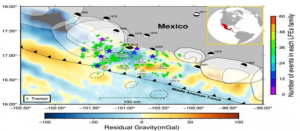
Figure 1. Map view of the study area in the Guerrero seismic gap. Triangles show the location of eight ocean bottom seismometers (OBSs). Circles represent tectonic tremors. Stars whose colour changes with the rightmost colour bar series represent the LFEs family, and different colours indicate the numer of LFEs in each family. Residual Gravity anomalies are from Plata-Martínez et al. (2021). The four dashes circles in the figure represent seamounts from left to right: Koyuki, Popped-up, Ender and Yoshi seamounts (Černý et al. 2020). The transparent circles represent the rupture areas of earthquake that have occurred over the past few decades.
- Email: esgarcia@nip.upd.edu.ph