

Caesar A. Saloma
Fields of Interest: Instrumentation
Academic Group: Instrumentation Physics Laboratory
Education: Doctor of Philosophy in Physics (University of the Philippines, 1989)
Dr. Caesar A. Saloma is a Professor of the National Institute of Physics (NIP) at the University of the Philippines (UP). He is also currently the Program Coordinator of the Instrumentation Physics Laboratory. He obtained his BS, MS, and PhD degrees from UP Diliman in 1981, 1984, and 1989, respectively. As a Monbusho scholar, he started working in optics in October 1987. His dissertation on speckle reduction in laser microscopy was supervised by Shigeo Minami and Satoshi Kawata of the Department of Applied Physics, Osaka University.
Saloma received the Galileo Galilei Award from the International Commission for Optics year 2004. He is the first scientist from an ASEAN member country to receive the Award. In 2005, Saloma was elected to the National Academy of Science and Technology (NAST). In 2006, the UP Board of Regents appointed him, to the highest rank of Scientist III in the UP Scientific Productivity System. He is the only UP faculty member to date who has been appointed to the rank of Scientist III for six consecutive three-year terms. In 2008, he received the triennial ASEAN Outstanding Scientist and Technologist Award from ASEAN Committee on Science and Technology during the 8th ASEAN Science and Technology Week in Manila, Philippines. Dr. Saloma was recognized for his contributions to photonics, optical imaging, and signal processing that were accomplished with NIP colleagues and students.
Saloma is a recipient of other awards and recognition including the NAST Outstanding Young Scientist (Applied Physics) in 1992, the NAST-Third World Academy of Science (TWAS) Prize in Physics in 1997, and the GAWAD Chanselor para sa Natatanging Guro (Outstanding Teacher) in 2006 and several Gawad Chanselor para sa Pinakamahusay na Mananaliksik (Best Researcher in S&T) from the UP Diliman. He also received from the Metrobank Foundation the 2007 Outstanding Teacher Award, and the 2014 Award for Continuing Excellence and Service (ACES). He received the 1999 DOST-NAST Outstanding R&D Award in Basic Research (Eduardo A. Quisumbing Medal for Basic Research) for his work on image compression of video and confocal images. He was included in the “51 Men and Women of Science” list that was released by the DOST for its 50th Anniversary celebration as a government department in June 2008.
He received the Presidential Lingkod Bayan Award for Outstanding Public Service, which is the highest recognition given to a Philippine government employee for outstanding work performance. He received the 2010 DOST-NAST Outstanding Science Administrator Award (Dioscoro L. Umali Medal) in recognition of his commitment, leadership, dedication and outstanding service as scientist, teacher and administrator. The construction of the National Science Complex which is managed by UP through the College of Science (CS), UP Diliman, was started and completed during his terms as CS Dean and UP Diliman Chancellor.
Saloma also served as the 9th Chancellor of the UP Diliman (February 2011 – February 2014), CS Dean (June 2006 – February 2011) and NIP Director (June 2000 – May 2006). He was elected Inaugural Fellow of the Samahang Pisika ng Pilipinas in 2008. He is the Editor-in-Chief of the Philippine Journal of Science since 2011.
Collision time in the inelastic bouncing ball model of granular materials
Caesar A. Saloma, Junius André F. Balista and Christian Jay Magsigay
Instrumentation Physics Laboratory, National Institute of Physics,
University of the Philippines, Diliman, Quezon City, Philippines
We modified the inelastic bouncing ball model (IBBM) to account for the role of collision time 𝜏𝑐 in defining the dynamics of vertically vibrated confined granular systems. Although 𝜏𝑐 was surmised to be consequential for dissipative systems, previous studies on the accuracy of IBBM did not formally incorporate 𝜏𝑐 as a dynamical variable of the model, focusing instead on other factors during flight, such as air friction. We utilized the discrete element method (DEM) to study the role of 𝜏𝑐 in the granular dynamics, and to cross-validate the efficacy of our reformulation of IBBM to account for the effect of collisions. When the 𝜏𝑐 value is greater than that of 𝑡0, which is the first instance that the container acceleration exceeds the gravitational acceleration 𝑔, the time-of-flight decreases, and the location of the bifurcation point shifts in the bifurcation diagram (time-of-flight versus dimensionless acceleration). We model 𝜏𝑐 as representing the range of uncertainty in the occurrence of 𝑡0. Assuming a separation of timescale between the dynamics of the collision between the center-of-mass (CM) of the granular system and the container, and the time-of-flight of the CM itself, we propose a supporting but separate model for the dependence of 𝜏𝑐 on Γ. The time-of-flight duration is determined when 𝜏𝑐 is known in the modified IBBM that now produces bifurcation diagrams which are in closer agreement with the DEM simulation results.
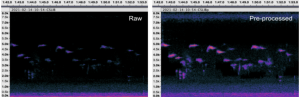
Fig 2. Sample spectrograms for raw and pre-processed.wav files opened in Audacity® Spectrogram View.
The x-axis represents the time expressed in seconds, while the y-axis represents the frequency expressed in kHz. Spectrogram parameters: linear scale, 8 kHz maximum frequency, and window size = 4096. Amplitude ranges from -60 dB to -44 dB (raw) and -60 dB to -29 dB (pre-processed). https://doi.org/10.1371/journal.pone.0289001.g002
Email: caesar.saloma@gmail.com
- Email: csaloma@nip.upd.edu.ph